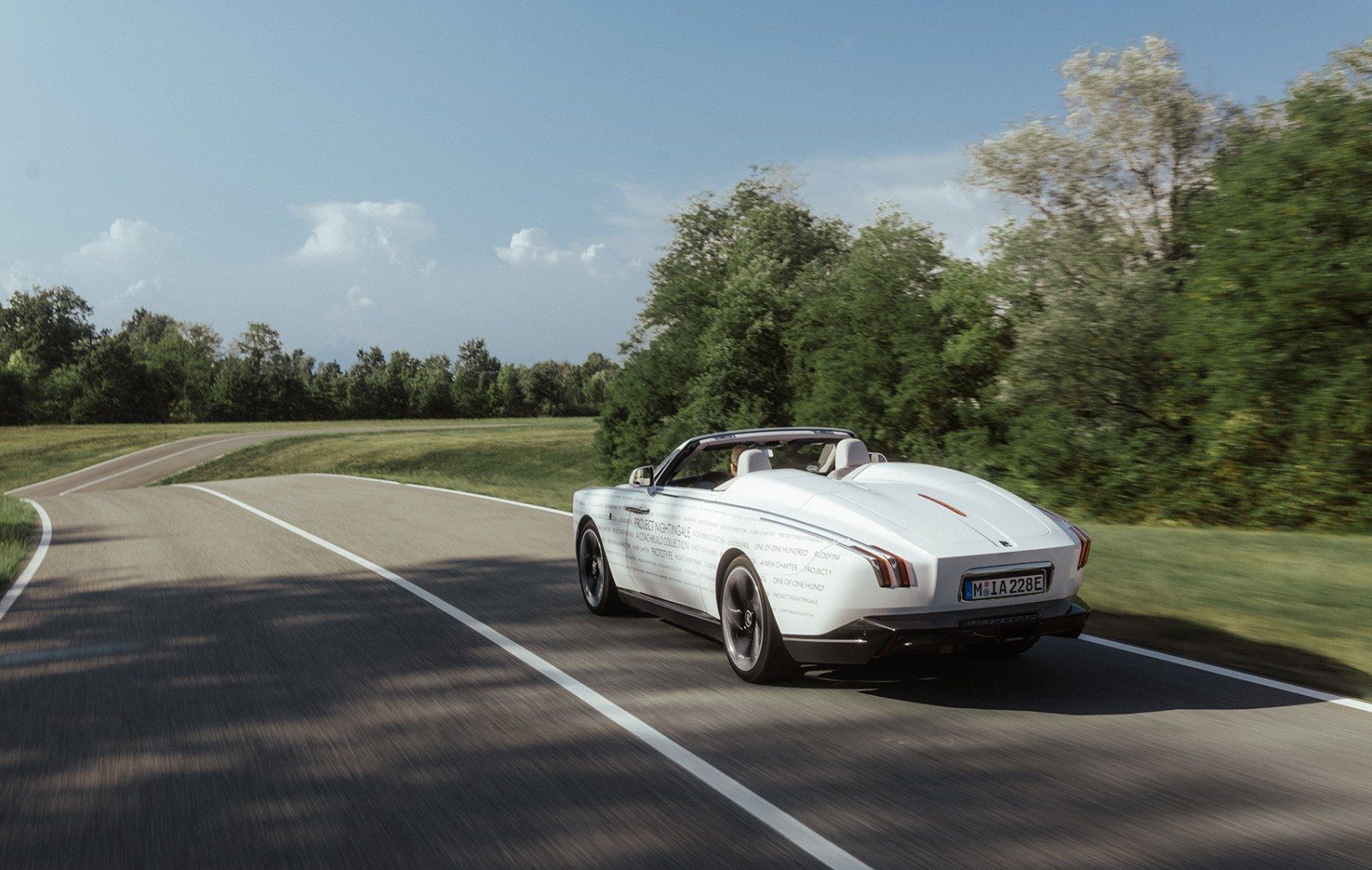

Rolls-Royce has begun on-road testing of Project Nightingale, the fully electric two-seat convertible that opens its new Coachbuild Collection, ahead of deliveries of 100 units from 2028.
Engineers will spend what the company calls “350 collective weeks” proving the car, the British carmaker said on Monday. The figure measures combined engineering effort across prototypes and teams, not the length of the programme.
Prototypes will run from Mediterranean coastal roads to the Arctic Circle and the deserts of the Arabian Peninsula, at altitudes of up to 2,750 metres (9,022 feet).
“Few motor cars in the marque’s history have asked so much of those who create them,” said Chris Brownridge, Chief Executive of Rolls-Royce Motor Cars. “Every detail is being refined to an extraordinary degree, down to the sound of the Piano Boot closing after 15,000 operating cycles.”
The Programme
Testing begins in southern Europe, starting in southern France. Project Nightingale takes its name from Le Rossignol, French for “the nightingale,” the house Henry Royce built for his designers and engineers near his winter home on the French Riviera.
More than a century ago, Rolls-Royce engineers ran speed and durability testing from that base, from the company’s test facility in Châteauroux and on the roads between Monte Carlo and London.
The road programme follows almost three years of development. Static prototypes have completed more than 1,430 hours of aerodynamic modelling, in digital simulation and in the wind tunnel.
Those results will be checked at a private high-speed facility, where the car will be driven at up to 250 km/h (155 mph) while engineers work to suppress wind noise.
Roof, Deflector and Boot
The roof is lined with a sound-deadening material that combines cashmere, fabric and high-performance composites. It will go through 10 separate tests of its fabric, closing mechanism and performance at temperatures of up to 80°C.
Rolls-Royce has developed a fully electric wind deflector for the car. It is meant to stop high-pressure air from looping forward into the cabin when the roof is down, and to help keep the interior warm in colder climates. Engineers will test it at a range of speeds.
The Piano Boot, a first for Rolls-Royce, opens sideways on a cantilever rather than lifting. It will be opened and closed up to 15,000 times.
The Model
Rolls-Royce revealed Project Nightingale on April 14 as the first model in the Coachbuild Collection, a tier of limited-production cars designed by the company for invited clients.
It is 5.76 metres long, almost exactly the length of the Phantom saloon, but seats two. It is built on the company’s Architecture of Luxury aluminium spaceframe and will be coachbuilt by hand at Goodwood.
The design draws on 16EX and 17EX, two experimental Phantom chassis that Rolls-Royce clothed in lightweight aluminium bodies in 1928 to reach new top speeds, and on the Streamline Moderne style of the late Art Deco era.
The electric drivetrain shaped the car’s look. With no need for large cooling intakes, the front carries a grille almost a metre wide with 24 vanes, flanked by slender vertical headlamps. A carbon fibre diffuser, which Rolls-Royce calls the Aero Afterdeck, replaces a spoiler, because there is no exhaust to route.
It rides on 24-inch wheels, the largest fitted to a Rolls-Royce. Inside, 10,500 lights in three sizes form a pattern the company says was derived from the sound-wave forms of a nightingale’s song.
Rolls-Royce calls the car a “production concept.” Its design is “fully resolved,” the company said in April, with a small number of details that require manufacturing techniques still under development.
“It will shape everything that follows,” said Domagoj Dukec, Director of Design at Rolls-Royce Motor Cars.
What Remains Undisclosed
Rolls-Royce has not published the car’s power, battery capacity, range or charging speed. It said in April that it would share further engineering details as testing progresses, and Monday’s announcement gave none.
The company describes the powertrain only as the marque’s “fully electric drivetrain,” the same wording it uses for the Spectre, its first electric model.
It has not published a price either. Autocar reported a starting price of about £7 million ($9.3 million), with personalisation expected to take the final cost higher.
Entry to the Coachbuild Collection is by invitation only. Several outlets have reported that the 100 cars were committed before the April reveal, which Rolls-Royce has not stated in its releases.
Clients are taking part in what the company describes as a multi-year programme of events tied to the car’s development. Each of the 100 cars will be specified with its buyer, using colours, materials and features Rolls-Royce says will not be offered on any other model.
Rolls-Royce Motor Cars is owned by BMW Group.