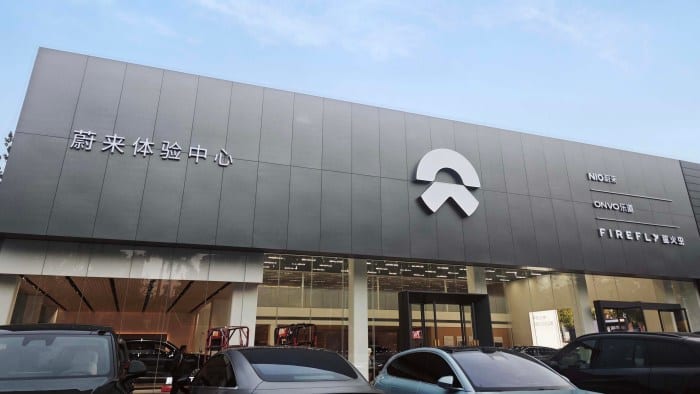
Fei Shen, head of Nio’s sub-brand Onvo and long-time Nio executive, criticized a sales pitch reportedly done by a sales staff that he said risks damaging the company’s reputation.
His remarks followed an online post circulating this Friday questioning how battery service options were being pitched to customers, which triggered a heated discussion on Chinese social media.
The controversy began after automotive blogger ‘水水兄同学’ shared on Weibo screenshots of a sales conversation on WeChat that described Nio’s battery rental plan as costly and risky, calling it a “trap that ruins the brand’s image.”
“For sales to talk like this, it greatly damages the brand’s goodwill,” Shen wrote on Weibo on Thursday.
“If this is a unified script, the sales leadership needs to be changed. If it is individual behavior, it is recommended to persuade resignation or directly fire,” the executive added.
Prior to lead Onvo, Fei Shen served as Senior Vice President of Nio leading the Power division — the unit responsible for the major battery swap technology developments achieved since 2018.
The remark followed a widely circulated post that shared screenshots of a purported conversation between a sales representative and a potential buyer.
In the chat, the salesperson described Nio’s battery-as-a-service (BaaS) plan as equivalent to a “high-interest loan,” warned that rental customers “lose ownership rights,” and claimed that second-hand car transactions would be “very troublesome” under the scheme.
The sales pitch concluded by calling the plan “a trap that ruins the brand’s image.”
The blogger suggested the comments may have come from frontline sales staff and responded by defending the program.
He wrote that BaaS is not mandatory, allows buyout flexibility, and has strong recognition in the used-car market.
“The Onvo L60’s BaaS version has practically become a second-hand car ‘god car,’ with a one-year value retention rate exceeding 80%,” he said.
He also noted that monthly rental fees can be offset against future buyout costs, that recent fee reductions were not being mentioned by critics, and that both state policy and CATL’s participation underscored battery swapping as a strategic national direction.
“Everything is transparent, where is the trap?” the blogger wrote, dismissing claims of a “consumption trap” and pointing to Nio’s August sales record of more than 31,000 units.
The brand, launched last year and aimed at family buyers, is anchored by the five-seat L60 and the larger six- and seven-seat L90, which has delivered more than 10,000 units in August.
Onvo was the primary growth engine for Nio Group’s delivery record in August, accounting for more than half of total sales.
The management said this week that the L60 model will get a minor facelift with further details being revealed soon.
Below is the transcript of the WeChat sales pitch which Fei Shen criticized.
“Boss, you can think about it yourself. With this battery rental plan, when you calculate it down, the annualized cost is 6.8%, no different from a high-interest loan.
Moreover, since battery technology is already very mature, offering an 8-year warranty, you don’t need to worry at all about degradation issues.
The main point is ownership of the battery. Once you choose rental, this ownership is completely gone, and the disadvantages of that are obvious. Even if you rent for 5 years, 8 years, the battery is still not yours. This kind of experience is completely different.
And if you later want to buy a second-hand car, the process is very complicated and lacks flexibility.
Because if the previous owner hasn’t settled all the rental payments, the follow-up scheme cannot be implemented. If you want to buy out the battery, you must buy it at the original purchase price.
Second-hand car disposal is also very troublesome. If you want to resell, the buyer must accept the battery rental plan.
If they don’t accept, you’ll first need to buy out the battery at original price before you can sell. This causes major inconvenience and reduces the liquidity of used cars.
The battery rental scheme also carries certain risks. All the costs and risks are borne by yourself. If something goes wrong with the battery, it’s not as straightforward as if you owned it outright — you may end up paying more.
So I suggest you think carefully. Don’t be tricked into this so-called “battery rental plan.”
If you calculate it, the battery alone costs more than 100,000 yuan, equivalent to buying a car for 40,000–50,000 yuan less.
Anyone can see this is a trap that ruins the brand’s image.”