Written by Cláudio Afonso | LinkedIn | X
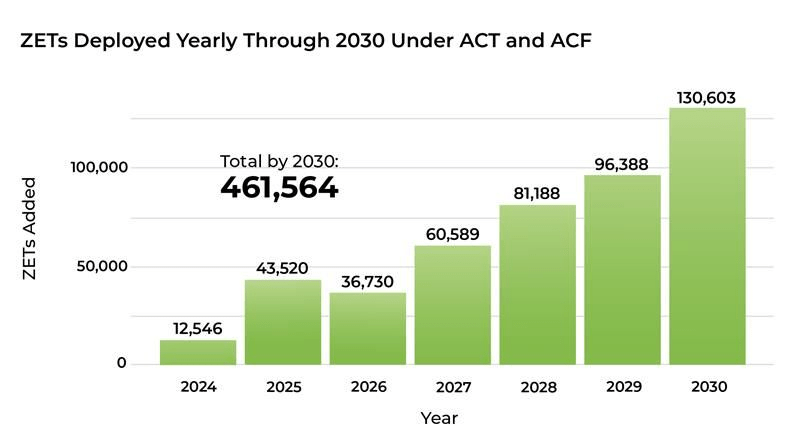
Annual sales of Zero-emission trucks (ZET) are expected to reach more than 460,000 units in 2030 across eleven U.S. states thanks to the ACT and ACF, two rules that will help increase the adoption of the ZETs, CALSTART forecasted in its latest study.
If the projection for this year is below 12,600 ZETs, the study forecasts that in 2030, over 130,500 units will be deployed — up from 43,520 in 2025.
The study expects two-thirds of these vehicles (306,000 units) to be in the pickup, straight truck, and delivery classes, while Class 8 tractor demand starts to increase later in the decade.
The Advanced Clean Trucks (ACT) rule, adopted by California in 2020, mandates that manufacturers of medium- and heavy-duty vehicles must sell an increasing percentage of zero-emission trucks, such as electric or hydrogen fuel cell trucks, starting in 2024.
In its latest assessment, the U.S. organization forecasted that the approval from the states on the Advanced Clean Trucks (ACT) rule combined with the adoption from California of the Advanced Clean Fleets (ACF) rule will allow significant growth in the sales of ZETs over the next years.
ACT was initially adopted by California four years ago, in 2021, with ten other states following such as Colorado, Maryland, Massachusetts, New Jersey, New Mexico, New York, Oregon, Rhode Island, Vermont, and Washington.
The Advanced Clean Fleets (ACF) rule is a complementary regulation focused on fleet operators aiming to accelerate the deployment of ZETs in government and large commercial fleets.
“By 2030, ACT and ACF compliance is projected to result in the deployment of at least 461,000 ZETs in the 11 states that have adopted these rules to date. Our new study highlights the importance of these rules for a sustainable future,” CALSTART wrote on LinkedIn.
Written by Cláudio Afonso | LinkedIn | X