

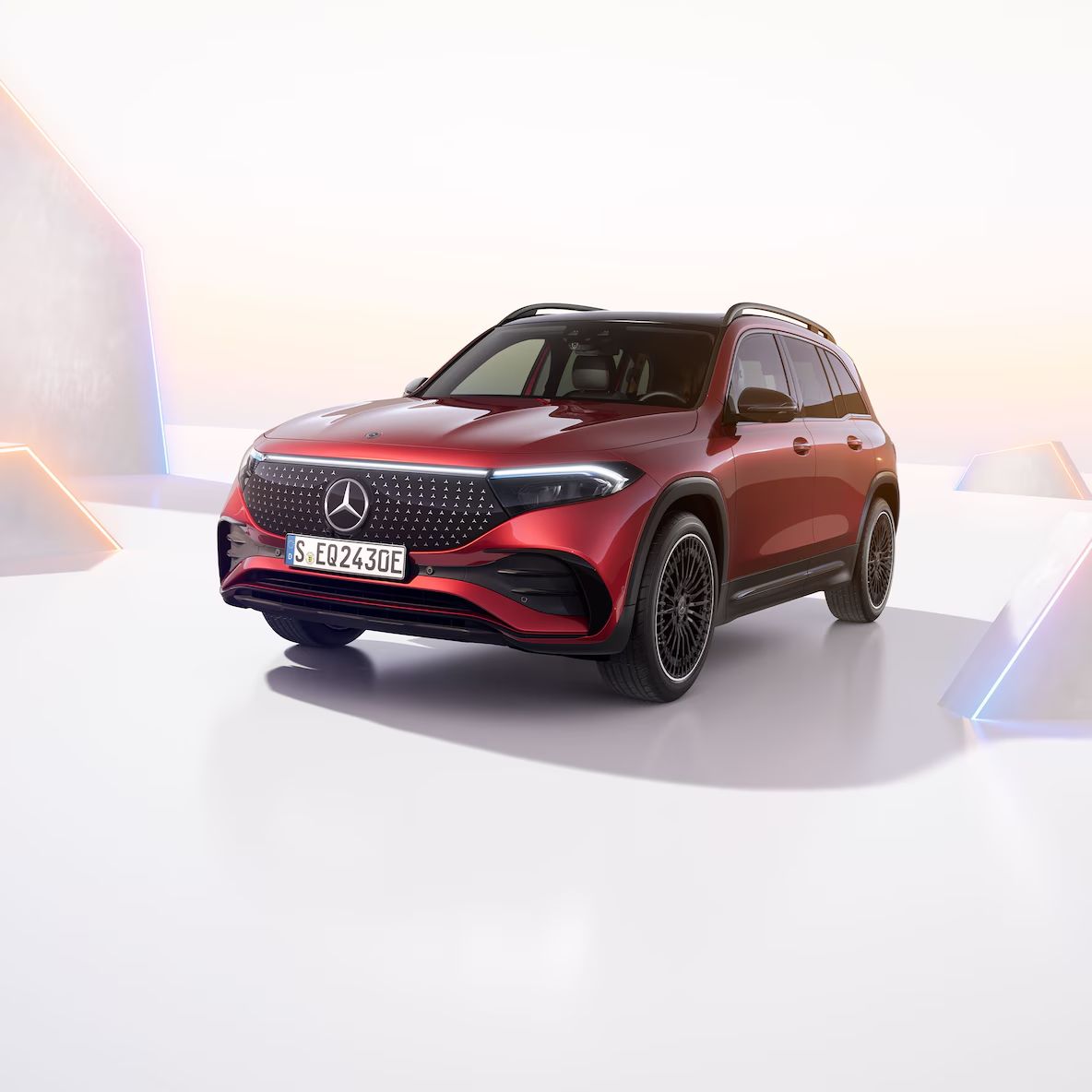

Mercedes-Benz recalled on Wednesday in the United States 11,895 vehicles of three of its battery-electric models due to overheating risks with its battery that could lead to fires.
The models affected include the EQB 250+, EQB 300 4MATIC, and the EQB 350 4MATIC.
The National Highway Traffic Safety Administration (NHTSA) stated in its latest report that the affected units’ high-voltage battery “may fail internally and lead to a vehicle fire while parked or driving.”
“Due to the combination of certain production and use conditions, an internal short circuit of a battery cell in the high-voltage battery might lead to a thermal event.” the organization explained.
It added that an “increased risk of a fire cannot be ruled out.”
According to NHTSA, manufacturing defects in early-production battery cells make the German automaker’s models vulnerable to internal short circuits when charged to high levels, especially when combined with external factors like charging infrastructure issues or physical damage.
The issues are found in 3,674 units of the Mercedes-Benz EQB 250+ SUV, from 2022 and 2023, and also 6,513 EQB 300 4MATIC and 1,708 EQB 4MATIC SUVs, both with model years between 2022 and 2024.
All vehicles were produced between December 2021 and May 2024.
Other EQB units outside of the listed range have battery cells that are “sufficiently robust at high state of charge,” the administration stated.
On February 6, NHTSA had reported that the luxury brand had recalled 12,236 vehicles, but it was replaced with the latest recall.
Mercedes-Benz advised owners of the affected vehicles to “only charge their vehicles to a maximum of 80% battery capacity” and to “park outside and away from structures until the recall repair is complete,” as described in Wednesday’s report.
The company will repair affected vehicles at no cost.
Drivers are expected to receive notification letters on February 27, with additional letters set to be sent “once the final remedy is available”
NHTSA mentioned that Vehicle Identification Numbers (VINs) involved in this recall are searchable on its website, starting on Friday.
Last month, Volvo experienced a similar situation in the US and other countries with its EX30 SUV. The Swedish automaker warned owners to limit battery charging to 70% and to “park outside”.
Last Year’s Recalls
Last year, Mercedes-Benz had recalls on several different occasions.
Exactly a year ago, the company recalled 12,236 vehicles, including all versions of the EQB from 2022-2025 (250, 250+, 300, 350) for a high-voltage battery that might have failed internally and led to a vehicle fire.
In the same month, it recalled 20,339 vehicles, including 2021-2022 S 500, Maybach S 580 4MATIC, 2021-2023 S 580 4MATIC, 2022 S 680 4MATIC, and 2023 S 580e 4MATIC, due to the possibility of the front brake hoses rupturing and leaking brake fluid.
As a result, this defect would extend the distance needed to stop the vehicle, increasing the risk of a crash.
In August, the brand recalled 3,749 units of its 2023–2026 EQE and GLC models, due to steering coupling bolts that were not properly tightened.
This issue was also the reason behind Polestar‘s recall of 213 Polestar 3 SUVs earlier this week.
US Sales
Mercedes‘ revenue in the United States declined by 11.2% year over year in 2025, to €30.974 billion ($36.802 billion) from €34.900 billion ($41.474 billion).
In the US, the brand’s passenger car sales fell 12.3% to 284,650 units, compared to the 324,529 vehicles sold in 2024.
This year, the company aims to sell 325,000 vehicles in the country.
