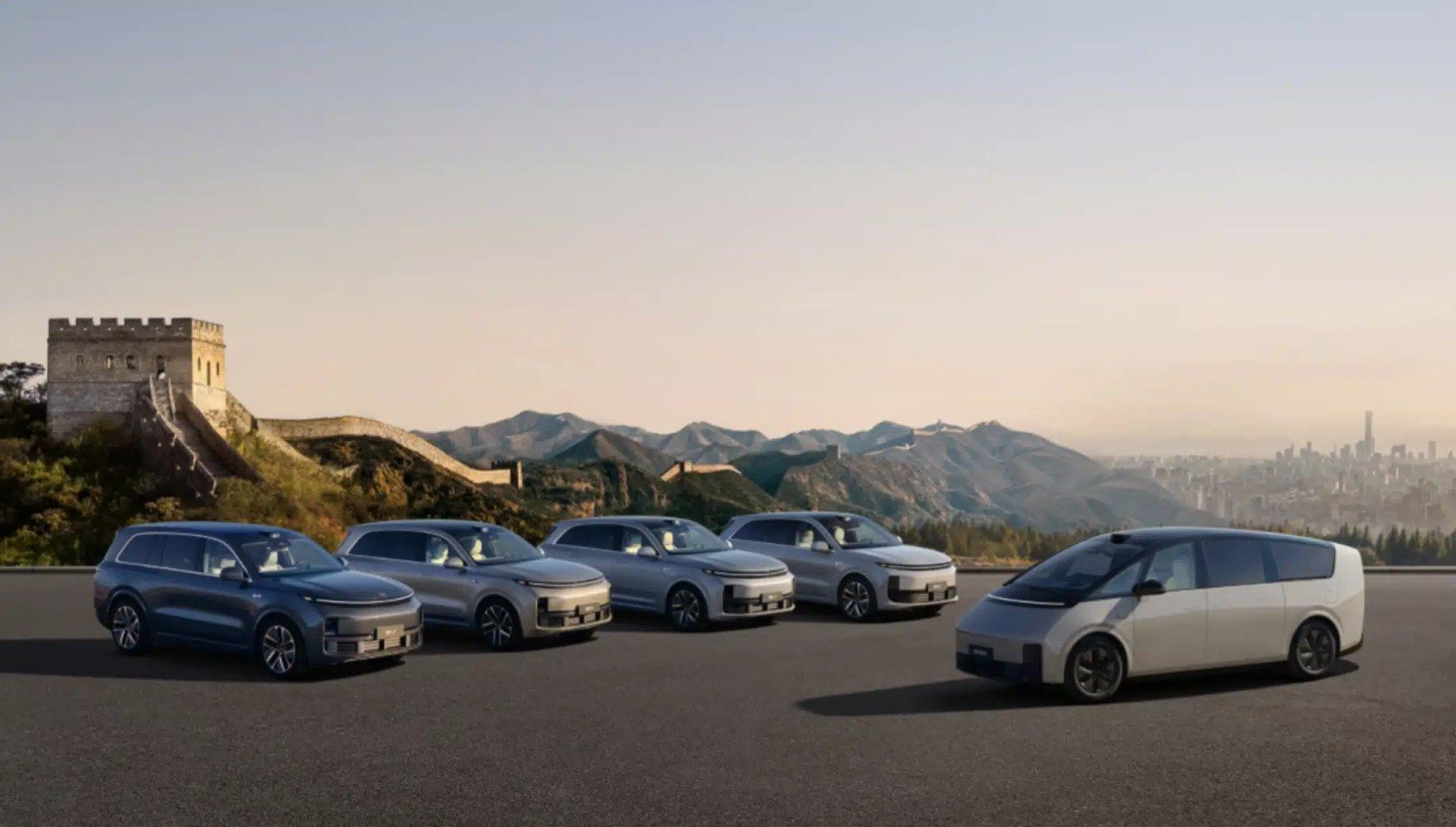

Li Auto announced on Tuesday that its vehicle sales fell both year on year and sequentially in June as the company prepares to launch its second fully electric model later this month.
When compared to a year ago, deliveries fell 24.1% to 36,279 units. In May, the company had reported its strongest month of the year with 40,856 units.
The Beijing-based carmaker had lowered its delivery estimates for the second quarter last week. Previously set at between 123,000 and 128,000 vehicles, the company said it expected to deliver “approximately 108,000 vehicles.”
Second quarter figures came in at 111,074 vehicles, slightly higher than the adjusted guidance and 2.3% above the 108,581 units delivered a year ago.
Compared to the first quarter’s 92,864 vehicles, deliveries rose 19.6%.
As reported in May by the local media outlet 21jingji, Li Auto had previously trimmed its annual delivery target from 700,000 units to 640,000, citing “weaker than expected” orders for the revamped Li L6 (the brand’s best-selling model).
Year to date, Li Auto has delivered 203,938 vehicles, completing 31.9% of the lowered target of 640,000 vehicles.
As of June 30, the brand had over 500 retail stores in 150 cities. As of the end of May, the company said it had 500 stores.
By the same time, Li Auto’s charging network in China had 2,851 super charging stations in operation equipped with 15,655 charging stalls. In June, the carmaker added about 2,500 stalls across China.
The automaker, which is mostly focused on extended-range electric vehicles (EREV), will launch in late July its second (BEV) model — the Li i8.
It comes after the launch of the Li Mega MPV, its first fully electric model, in September 2024.
“Families in need of a spacious six-seater vehicle, see you in July,” the company’s founder and CEO Xiang Li wrote on Weibo.
The Li i8 is a mid-to-large-size SUV that will integrate next-generation LiDAR powered by Nvidia’s Thor chip. The model will come standard with lithium ternary batteries that support 5C fast-charging.
The Li i8 will be followed by a smaller Li i6 SUV, a five-seater set to be launched later in September.
“We aim to provide families considering the Mercedes-Benz GLC, BMW X3, or Audi Q5 with an additional purchasing option,” the chief executive stated on Weibo.
On Monday, the company announced it surpassed 15,000 supercharging piles, which include 1,575 5C supercharging stalls, with a peak charging power of 520 kW.
As of June 19, Li Auto operated 2,500 supercharging stations in China. It aims to reach 4,000 by the end of the year.
Last week, as it updated its delivery target, the company announced an internal restructuring aiming to strengthen its “smart car capabilities.” Li Auto will combine its sales and service division with its R&D and supply chain teams.
Li Auto sold 8,000 vehicles between June 23 and 29, according to data shared on Chinese social media this Tuesday. In the prior week, the brand had sold 8,900 units.
Most automakers saw their sales performances increase in the last week of June, contrarily to Li Auto. Both Xiaomi and XPeng set record registrations, with 11,200 and 9,100 units, respectively.
Huawei-backed Aito sold 11,700 vehicles last week, and Leapmotor listed 10,600.
U.S. brand Tesla also saw sales figures rising over 50% week over week to 20,700 EVs in China. The Elon Musk-led company remained the second best-selling new energy vehicle brand in the country.