
François-Philippe Champagne told Canadians in May 2024 that the country would “never” serve as a backdoor for Chinese EVs into North America.
He repeated the pledge in August, October, December, and again in March 2025.
Eighteen months later, as Canada’s Finance Minister, Champagne returned from a four-day trade mission to Beijing where he promoted deeper economic ties with the country whose vehicles he had vowed to keep out.
Canada’s 100% surtax on Chinese-made EVs — which Champagne helped design and publicly championed — was replaced in January with a quota allowing 49,000 vehicles per year at a 6.1% tariff.
The Pledge
Champagne’s public opposition to Chinese EV imports began on May 17, 2024, days after US President Joe Biden announced a 100% tariff on Chinese electric vehicles.
“Canada has never been and will never be a backdoor for China in the North American market, and our US friends understand that,” the then-Innovation Minister told CBC. “It’s fair to say that everything is on the table to protect our industry and our workers.”
At the time, Ottawa had committed tens of billions of dollars in subsidies to attract EV manufacturing from Honda Motor Co., Stellantis, and Volkswagen Group.
Champagne framed cheap Chinese imports as an existential threat to those investments.
On August 26, Prime Minister Justin Trudeau announced the 100% surtax from the Liberal cabinet retreat in Halifax.
Champagne, in the official statement, cited 550,000 direct and indirect jobs in Canada’s auto supply chain. “This is about securing the fair, prosperous future Canadians deserve,” he said.
In the government’s October 1 implementation notice, he said Ottawa was “taking further action to protect Canadian workers from China’s unfair, non-market practices” and pledged to foster domestic EV supply chains “from mining critical minerals to manufacturing batteries and vehicles right here at home.”
On October 18, he posted on X: “Tariffs on EVs, steel, and aluminum from China ensure a fair and competitive environment for everyone. But, we also know our businesses need time to adjust their supply chains away from Chinese products.”
The language signalled structural decoupling.
By December 2024, he was still on message, warning on X that “if you say no to Canada you are basically saying yes to China” on strategic supply chains.
As late as March 12, 2025 — ten months before the deal that reversed the tariff — Champagne was asked by CTV News whether Canada would soften its position.
“We’re not. Not with respect to the tariffs that we put because there was a good reason,” he said. “We will say we would never be a back door to cheap Chinese vehicles which are overly subsidized and where they don’t respect labour law and environmental laws.”
He added: “We want to protect our industry. We want to protect our workers. We want to protect our communities. And the reason why we impose the tariff still remains very valid today.”
The Deal
Mark Carney replaced Trudeau as Liberal leader and Prime Minister in late 2025.
A former governor of the Bank of Canada and the Bank of England, Carney brought a more transactional posture toward Beijing.
On January 16, during a state visit that included a meeting with President Xi Jinping, Carney announced the agreement that dismantled Champagne’s tariff regime.
The 100% surtax was replaced with a managed quota: 49,000 Chinese-built EVs per year at a 6.1% tariff, rising to 70,000 by 2030.
In exchange, China lowered tariffs on Canadian canola seed from approximately 85% to 15% and eased duties on lobster, crab, and peas.
The 49,000 figure closely matches the volume of Chinese-built vehicles — predominantly Tesla Model Ys from Shanghai — that entered Canada in 2023 before the surtax took effect.
Ontario Premier Doug Ford labelled Chinese EVs “spy vehicles.”
Conservative leader Pierre Poilievre called them “roving surveillance systems.”
The Canadian Vehicle Manufacturers’ Association, representing Ford Motor Co., General Motors Co., and Stellantis, warned the deal “has the potential to undermine Canada’s auto sector.”
Trump threatened a 100% tariff on all Canadian goods entering the United States if Ottawa finalised the arrangement. Carney responded that Canada had “no intention” of pursuing a free trade agreement with China.
Champagne, by then, had been appointed Finance Minister — a role that placed him at the centre of the new bilateral economic relationship rather than the industrial policy portfolio that had made him a hawk.
The Beijing Trip
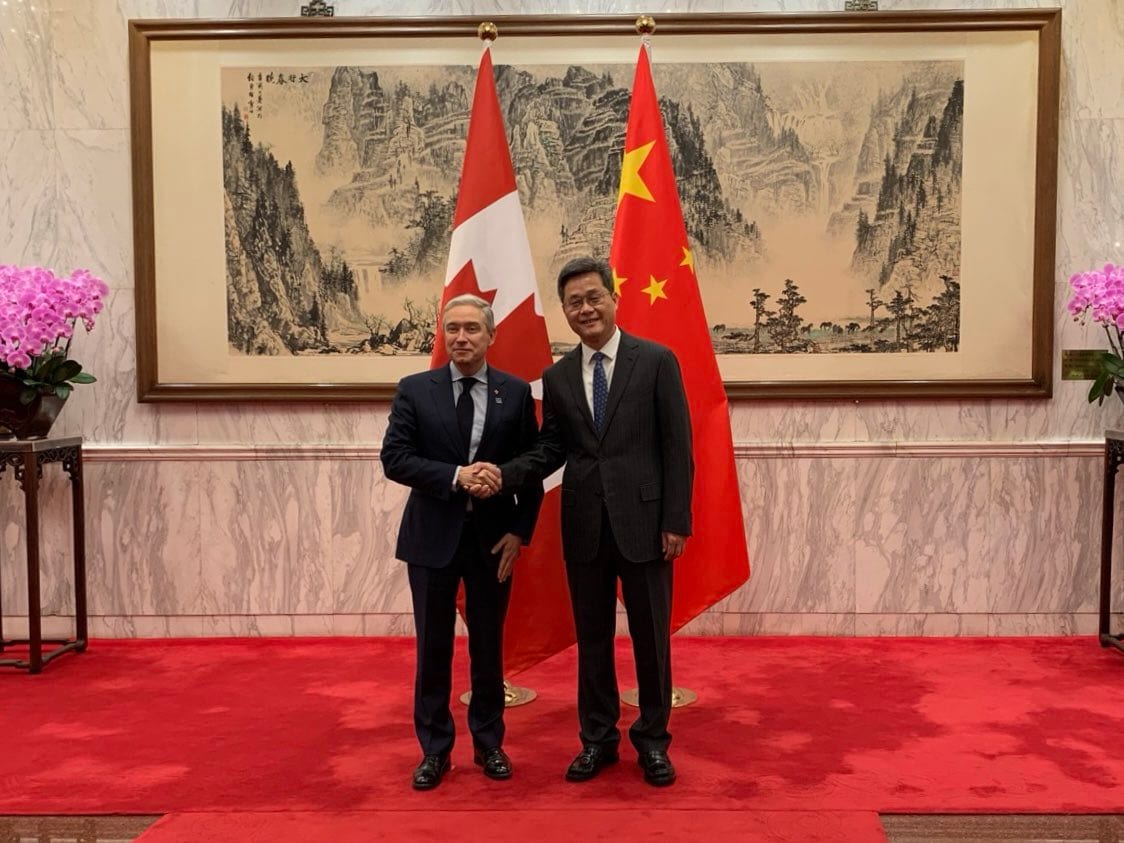
Champagne visited the Chinese capital from Tuesday to Saturday last week, accompanied by the Governor of the Bank of Canada, the Superintendent of Financial Institutions, and the chief executives of Manulife Financial Corp. and Sun Life Financial Inc.
In a press conference on Friday, April 3, following the mission’s conclusion, Champagne said the visit was focused on financial services — not the auto sector.
“If you want to diversify, you need to show up,” he told reporters, describing the trip as “putting the vision in action” established by Carney’s January summit with Xi. He confirmed that China’s Vice Premier He Lifeng is expected to visit Canada as part of the new dialogue.
When the National Post asked directly whether he had raised the issue of forced labour or human rights with his Chinese counterparts.
“We did speak about supply chain integrity. That was a core message. Canada puts a lot of importance on supply chain integrity and that our bilateral trade needs to be conducted in accordance with international standards.”
He did not use the words “forced labour” or “human rights” in his answer.
When Bloomberg asked whether the government would support Stellantis using its Brampton, Ontario, plant to manufacture Leapmotor electric vehicles, Champagne pivoted.
The government’s focus, he said, was on ensuring Stellantis “respect the letter and the spirit of the commitment they made to the government of Canada and to the workers” — without addressing the broader question of Chinese EV production in Canada.
Asked whether there were substantive discussions about Chinese auto industry investment, Champagne was direct: “No, we did not speak about the auto sector per se.”
The vocabulary had changed. “Supply chain integrity” replaced “forced labour.” “International standards” replaced “Chinese labour abuses” while engagement “with eyes wide open” replaced “never a backdoor.”
The Numbers
The structural gap between Champagne’s 2024 rhetoric and the 2026 reality is quantifiable.
Tesla and Geely Group brands — including Volvo and Polestar — are expected to be the first beneficiaries of the quota. All manufacture in China and hold existing Canadian regulatory approvals.
BYD Co., Chery and Geely are preparing market entry by year-end.
An audit of Transport Canada’s Appendix G importer registry conducted by EV found that BYD is the only Chinese-headquartered automaker registered to import passenger cars from China — a preclearance requirement that every other Chinese brand has yet to complete.
The Context
Canada’s auto sector has contracted on multiple fronts. US tariffs on Canadian-made vehicles are running at an effective 10-12% on non-US content.
GM cancelled BrightDrop electric commercial vehicle production in the country. Stellantis moved Jeep Compass production from Ontario to Illinois.
Canada remains the only North American vehicle producer operating below its pre-pandemic output baseline — 1.2 million units in 2025, down 33% from 2019.
Rising fuel prices have simultaneously increased consumer interest in electrification.
The Iran conflict pushed gasoline to $4.11 per gallon before a two-week ceasefire was announced on Tuesday.
A Leger survey of 1,659 Canadians, published by financial comparison platform Rates.ca, found that 30% are now open to purchasing an EV.
Among those interested, 56% said they would consider a Chinese-built model if the price were right.
The Pressure Builds
The forced labour issue that Champagne navigated carefully in Beijing has intensified since his return.
On Wednesday, Canada’s auto manufacturing lobby seized on fresh allegations against BYD to renew its opposition to the Chinese automaker’s market entry.
Days after Brazilian authorities added BYD to a government blacklist over what labour inspectors described as “slavery-like” conditions at a factory in Camaçari, Bahia, an upcoming report by New York-based China Labor Watch found similar conditions at BYD‘s Hungarian plant in Szeged.
CVMA President Brian Kingston called the findings “deeply concerning.”
Speaking with CBC, he said: “Canada’s auto industry can compete and win, but the playing field must be level.”
It is the same argument Champagne made in 2024 to justify the tariff he now administers the reversal of.