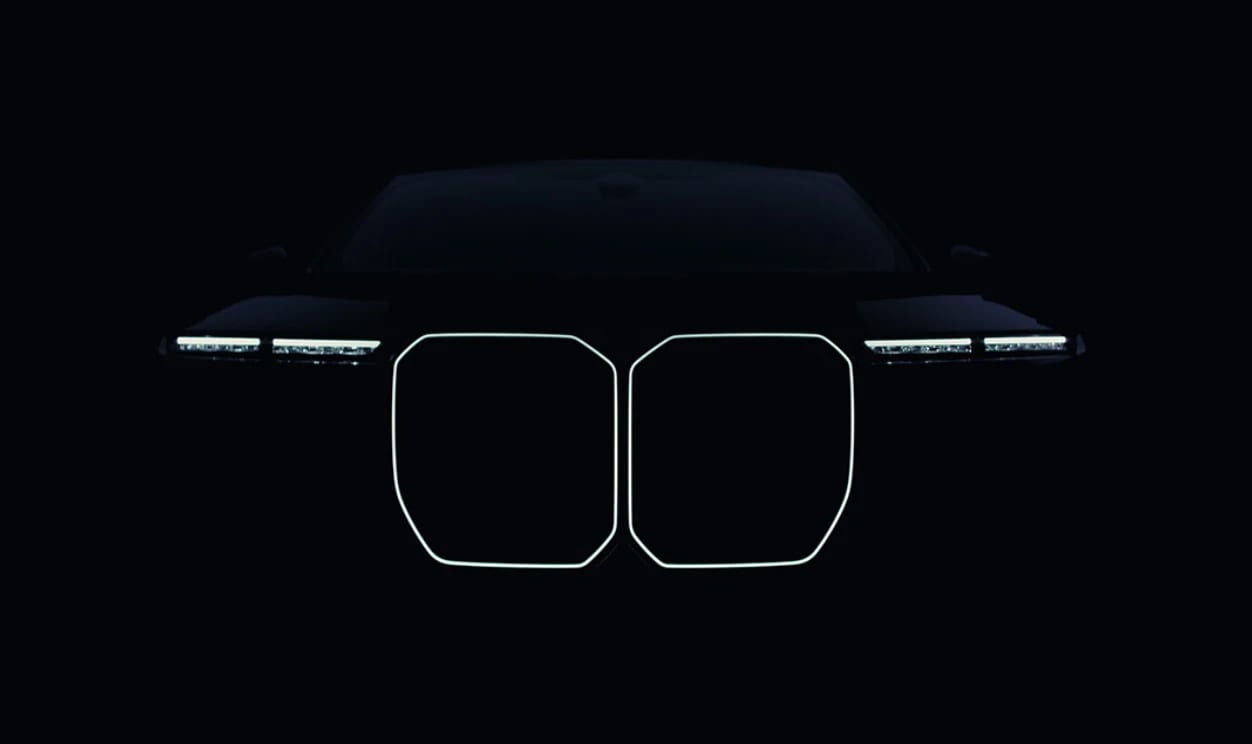

BMW Group and Rimac Technology announced on Tuesday that the new BMW i7 will become its first fully electric model to use a battery system jointly developed by the two companies.
The pack combines BMW‘s sixth-generation 4695 lithium-ion cylindrical cells with the automaker’s fifth-generation module-based architecture, in what both companies described as a scalable design.
The battery system is jointly developed and manufactured at the Rimac Campus near Zagreb, Croatia.
Neither BMW nor Rimac disclosed capacity, range, or charging figures for the new i7.
Full technical specifications are expected at its premiere on April 22, during the Beijing Auto Show.
Rimac x BMW
A subsidiary of Croatia’s Rimac Group, Rimac Technology is a Tier 1 supplier of high-performance EV components — including battery systems and electronic control units — to automakers such as BMW, Porsche, Hyundai, and Bugatti.
The technology partnership between BMW and Rimac was established in 2023.
For the i7 program, Rimac built a new production facility, industrialized two full production lines, and set up an end-to-end supply chain within a few years.
The area dedicated to the project covers 15,000 square meters within a 90,000-square-meter campus, with 70% of the site’s total capacity committed to battery system production across several programs for global automakers.
Nurdin Pitarević, CEO of Rimac Technology, said BMW had treated the Croatian firm “not just as a supplier, but as a true technology partner,” describing the project as an example of how carmakers and technology companies should collaborate in the future.
Neue Klasse
Thomas Engelhardt, Senior VP for high-voltage battery and charging development at the BMW Group, said the company is rolling out Neue Klasse technologies across its entire model portfolio, including its fully electric luxury sedan.
He called the cooperation with Rimac “a strong example of European innovative strength.”
The i7 update signals BMW‘s strategy of deploying Neue Klasse battery technology across its broader portfolio, even as the sedan remains on its existing CLAR architecture
The company officially revealed the fully electric BMW i3 sedan last month.
Despite reviving a nameplate previously used on a carbon-fibre city hatchback sold between 2013 and 2022, the new i3 is a full-size electric sports sedan positioned as the electric counterpart to the 3 Series.
The i3 will enter series production at BMW‘s Munich plant in August.
BMW has said most of its future EVs — including an electric 3 Series Touring wagon and larger models — will be built on the same architecture, with production spread across Munich and Debrecen (Hungary), among other plants.
The current i7, launched in 2022, is built around a 101.7 kWh usable battery pack and is sold in three variants: the rear-wheel-drive eDrive50, the all-wheel-drive xDrive60, and the M70 performance flagship.
US prices for the 2026 model year start at $105,700 for the eDrive50 and rise to $168,500 for the M70.
EV Sales
Globally, the BMW Group — including both BMW and Mini — delivered 442,072 fully electric vehicles in 2025, with European battery electric vehicle (BEV) sales growing 28.2% year-on-year.
While BMW of North America set a third consecutive annual sales record in 2025 with 388,897 vehicles, fully electric sales fell 16.7% to 42,484 units following the removal of the federal EV tax credit by the end of the third quarter.
The slowdown deepened in early 2026.
BMW sold 84,231 vehicles in the US in the first quarter, a 3.9% decline from the first quarter of 2025, with combined BEV and plug-in hybrid sales falling roughly 50% to 9,856 units.
The company has pointed to the upcoming US launch of the Neue Klasse-based iX3 — named World Car of the Year and World Electric Vehicle of the Year earlier this month — as a key catalyst for its EV business in the market.
BMW has yet to publish the first-quarter delivery figures for China.
The broader Chinese market remained under pressure in the first two months of the year, with passenger car sales down 18.9% and EV sales down 25.7% year-on-year, following the phased return of the vehicle purchase tax on electric vehicles.
In China, the BMW Group sold 625,527 units in 2025, a 12.5% year-on-year decline.
It was the automaker’s weakest result in the market since 2017-2018, as domestic rivals continued to erode the German brand’s pricing power.
On Tuesday, BMW executives publicly questioned the real-world value of BYD‘s second-generation Flash Charging technology — arguing that the Chinese giant’s headline figures come at the cost of range, durability, and affordability.
Speaking with Australia’s largest online automotive classifieds network Carsales, the company stated that the upcoming Neue Klasse models already charge fast enough for most real-world use cases.